Real Reflections: That Time John Cena Made A Rap Album
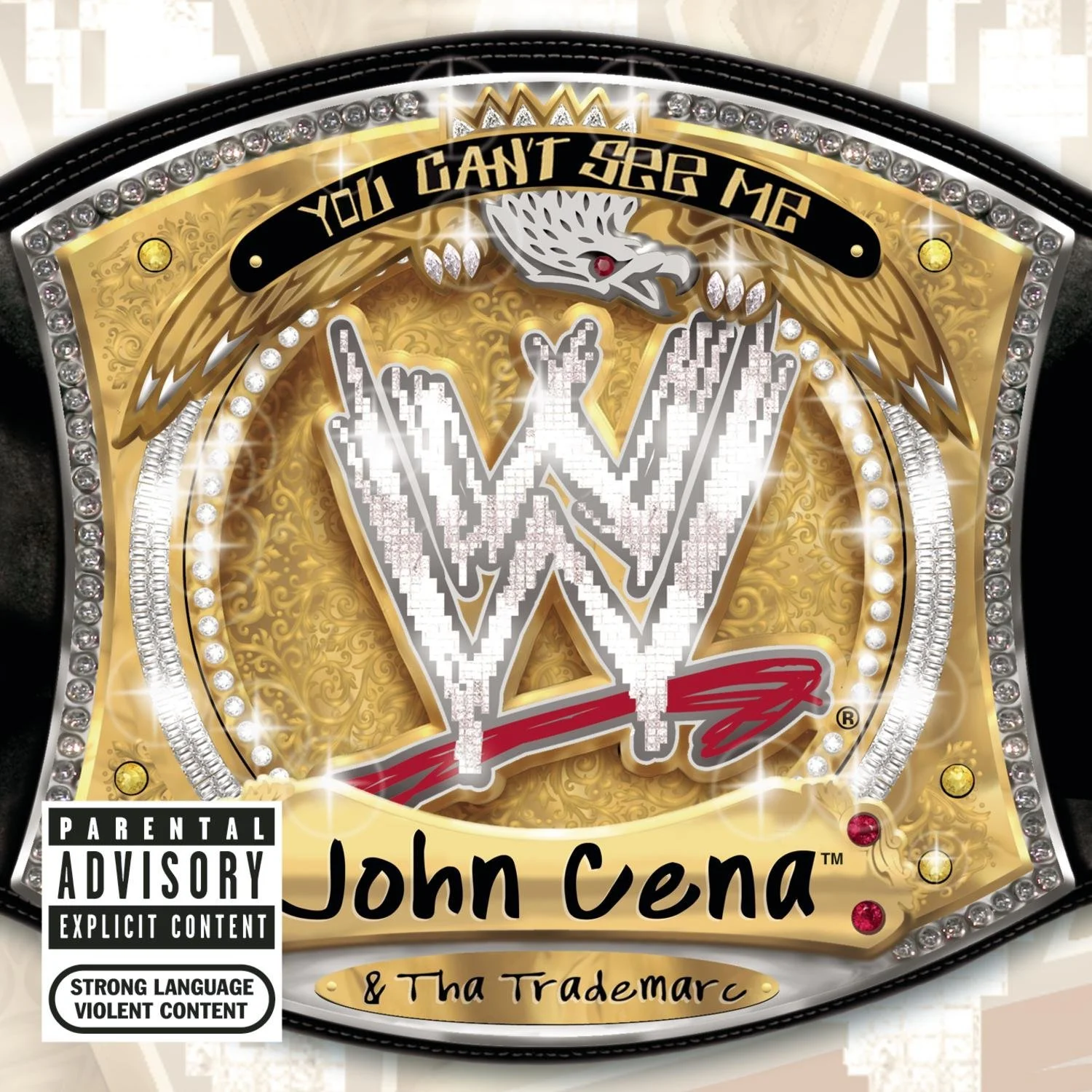
You Can’t See Me cover art
This article features certain words and phrases used within the wrestling community that might not be understood by casual observers. Here is a quick index to help: Heel– The Bad Guy Face– The Good Guy Kayfabe– The fictitious storyline that pro-wrestling exists within (i.e. 4th Wall) Heat– Negative Energy that fans give to heels (this is intentional; heels are supposed to be boo’d as a foil to the faces’ cheers). Gimmick– A wrestling character’s persona Turn– when a wrestler transitions from a heel to face or vice versa. Cutting a Promo– Speeches wrestlers give while in character Mic Work– A wrestler's ability to cut an effective promo
On Saturday, December 13, 2025, the greatest professional wrestler of all-time stepped foot into the squared circle for one last time. For the last two decades, John Cena has entertained audiences around the world with feats of incredible human strength, a charismatic persona, and an inspirational work ethic. What does any of this have to do with a music discovery platform, you might ask? Well, if you are asking that, then that probably means you’ve never closely followed pro-wrestling before because otherwise, you would already know, as Cena’s cultural impact extends far beyond the ring. In 2005, he famously bridged together the worlds of pro-wrestling and hip-hop by becoming the first wrestler to drop a platinum-selling rap album, You Can’t See Me. That’s right, we’re not here to talk about the 17-time World Champion’s hall of fame wrestling career. Instead, we’re gonna talk about his 17-track debut album in our first-ever “Real Reflection,” a written series reflecting on the intersections between culture and the music we love.
To understand how You Can’t See Me came to be, you have to understand how Cena’s wrestling persona at that time came to be one of a white rapper who would cut promos by freestyling tongue-in-cheek rhymes to insult his rivals. Prior to this, John Cena’s gimmick was “The Prototype,” a fairly generic character who boasted his athleticism and “ruthless aggression” toward opponents. While Cena was impressive in the ring, The Prototype was far from a groundbreaking character and failed to connect with wider audiences. It wasn’t until one fateful road trip that WWE’s then-director of creative writing, Stephanie McMahon (daughter of ex-WWE owner/devil incarnate Vince McMahon), happened to share the same bus as Cena and other wrestlers when they began freestyling to pass the time. She heard him spit and was so impressed, that she came up with the idea to rebrand Cena’s entire character into that of a gangster rapper on the spot.
As Cena explains in an interview with pro-wrestling journalist Chris VanVliet, he was pretty much on the verge of losing his job with the WWE at that point before rebranding into this new gimmick. “That’s where ‘never give up’ came from... I was one of the guys that was gonna get his pink slip until ‘hey, we’re gonna fire you but do you wanna do this thing? Yep, let’s go.’ And I was vaulted into a character that I had to create and take ownership of, that was only a small sliver of my life. I loved hip-hop music and I could freestyle pretty good, and I just dove right in and it worked.”
This is the mid-2000s, and while hip-hop music was still some years away from being the most consumed genre in the world, it’s pop culture impact was undeniable, particularly gangster rap. 50 Cent’s The Massacre was Billboard’s #1 album of 2005, 3-6 Mafia just won an Oscar for Best Original Song for the film Hustle and Flow, and The Diplomats were among the leading trendsetters in fashion.
While the WWE has infamously had a problematic history when it comes to respecting their Black fans and talent, Black culture was and still is undeniably profitable in our capitalist society. Thus, Cena became the perfect face to become the brash, rebellious gangster rapper while still being palatable for white audiences. At the same time, this gimmick gave his character heat because who could take an obnoxious white guy from West Newbury, Massachusetts with a blaccent in baggy clothes, and an actual chainlink chain calling himself the “Doctor of Thuganomics” seriously?
Unexpectedly, or expectedly depending on who you ask, his new gimmick connected with fans across all demographics thanks to his impeccable charisma and respect for hip-hop culture and it’s pioneers. It also helped that Cena was actually GOOD at rapping, good enough to rap over a 9th Wonder in a collab track with Murs, and brushed shoulders with hip-hop heavyweights at the 2004 Source Awards and 2005 Vh1 Hip-hop Honors. Cena notably also rapped his own entrance song at the time, “Basic Thuganomics,” an undeniable hit among wrestling fans who gravitated toward his character, helping him earn a face turn as a fan favorite and boost his status within the company.
Cena would work his way up the ladder thanks to his penchant for cutting memorable promos involving freestyles and in-ring athleticism. In 2005, he earned an opportunity to hold the top title within the company– the WWE championship– after a feud with previous champ JBL, who was one of the most hated heels in WWE history by leaning into a gimmick that was a cartoonishly evil caricature of a malicious, literally racist businessman. When the two faced each other at Wrestlemania 21, they stood on opposite ends of the cultural spectrum. JBL– with his signature cowboy hat and Southern drawl– could easily be a stand-in for country music and conservative politics, while Cena— with his signature jean shorts and oversized chain— represented a new era being led by the youth in the streets and hip-hop artists of that time.
After becoming the champion, Cena helped redesign the aesthetic of the classic gold belt design into a customized spinner belt inspired by the famous spinner chains of that era. Before becoming the Doctor of Thuganomics, Cena’s tenure with the company was on thin ice, but now he was officially the top guy in the company, a position he would hold the majority of his career. This was largely thanks to his ability to put on incredible wrestling matches and entertain fans, specifically by relating to them through hip-hop. So, the next natural step for the WWE to do after trusting him as their flagship champion, was to fund a full-length rap album that would essentially serve as a way to help Cena market both himself and the WWE brand even further.
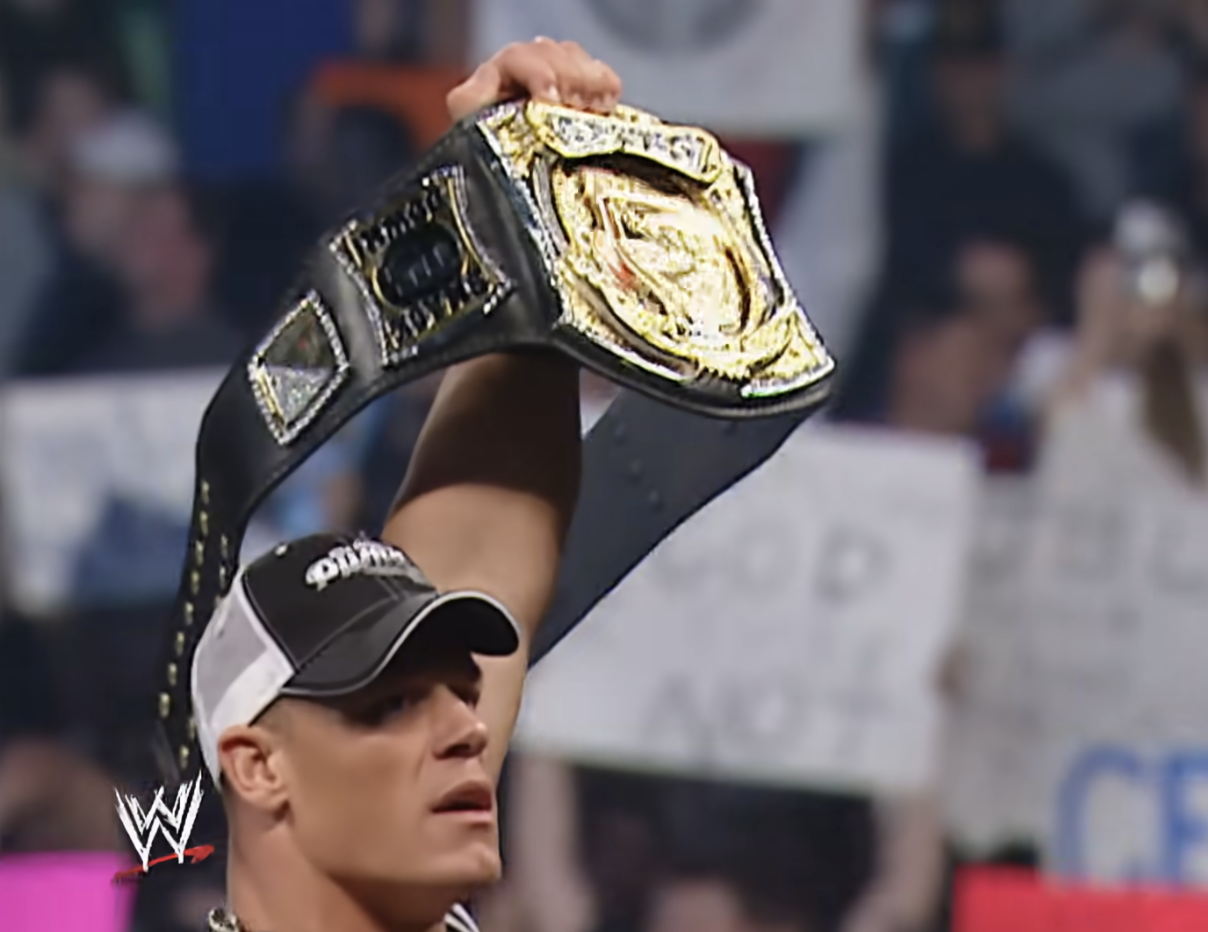
Cena Debuting The New Spinner Belt IN CHICAGO.
Even if you have never listened to the entirety of You Can’t See Me, you’re likely to be familiar with the track’s eponymous lead single, “The Time is Now,” which became Cena’s new entrance song in 2005, and also became meme’d into oblivion during the mid-2010s with videos of seemingly innocuous clips suddenly transitioning into a full-on John Cena fan cam with those iconic horns blaring at maximum volume to catch unsuspecting viewers off guard. It’s easily the most recognizable WWE theme song today, but even more than that, its an objectively great intro to a rap album.
You Can’t See embodies a time in hip-hop where big horns and braggadocio bars dominated the airwaves. It also introduces you to rapper The Trademarc, John Cena’s cousin, and the other half of this album’s collaborative process, whose name is written in a much smaller font on the cover beneath John Cena, but it is indeed a collab album between the two. Personally, I found their dynamic to be one of the most interesting things about the album. While John Cena mostly stays in character with bars that reflect himself as being the most badass guy in every room he steps in, The Trademarc’s verses come with a certain chip on his shoulder you can only hear in underground rappers trying to prove themselves. It helps give the album a little bit more authenticity, and both deliver in their respective roles, in my opinion.
This isn’t meant to be a full-length review of the album, but it's a solid listen with some pretty dope songs besides the intro. Personal favorites of mine are the more thoughtful “Right Now,” a smooth chipmunk soul-style song in the same vein as Kanye’s early College Dropout-era, and “Know The Rep,” which sounds like it could have been in the NBA Street Vol. 2 soundtrack. There are times where the album does feel dated and a bit bloated, clocking in at a 65-minute run-time with multiple songs being over 4 minutes, but with this generation’s increasingly short attention spans, it’s easy to forget that was more or less the standard for albums at that time.
As time progressed, WWE would shift its image into being more family-friendly, and so to would Cena’s image shift from a freestyling “thug” into the inspirational, never-give-up persona that gave young children someone to look up to, as evidenced by his Guinness World record for being the most requested celebrity for the Make-A-Wish foundation. Throughout that entire time, though, whenever he stepped out into the ring to give it his all, the first thing anyone in the stadium would hear would be those iconic, blaring trumpets of his theme song. If you came of age during the mid-2000s, listening to John Cena’s rap album feels like opening a time capsule of hip-hop and wrestling nostalgia, which can be quite refreshing to hear as a fun change of pace from today’s music trends. There were an additional 70 songs Cena recorded, but don’t expect those to be released any time soon, or at all, as Cena has stated he has no plans whatsoever to revive his music career. Thus, You Can’t See Me remains the only Platinum-selling album to have no follow-up then, now, (and likely) forever.